
Date: 19th May 2026
Media coverage - Australian Mining Magazine: COEMinerals researcher A/Prof. Liza Forbes comments on the consortium (academic-industry) model allowing "companies to share knowledge and accelerate innovation"
Australian Mining Article:
UQ-led program advances next-generation mineral processing
The University of Queensland’s (UQ) Collaborative Consortium for Coarse Particle Processing Research (CPR Program) is entering a second five-year phase aimed at advancing mineral processing technologies that could reduce energy use and waste across the global mining sector.
Led by researchers from UQ’s Sustainable Minerals Institute, the CPR Program brings together some of the world’s largest mining companies to collaborate on pre-competitive research focused on coarse particle flotation technologies.
The consortium’s second phase, running from 2025 – 2030, includes partners such as BHP Group, Rio Tinto, Newmont, Vale and Codelco.
The program is focused on understanding and expanding the capabilities of coarse particle flotation technologies, including fluidised bed flotation, which can separate valuable minerals from rock without requiring extremely fine grinding.
Comminution, the crushing and grinding of rock, is estimated to consume around two per cent of all electrical energy generated globally, meaning advances in coarse particle flotation could significantly reduce energy requirements and mine waste.
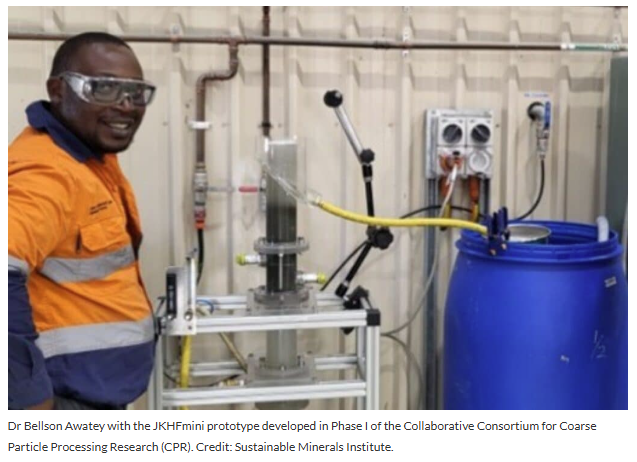
CPR Program director and Julius Kruttschnitt Mineral Research Centre associate professor Liza Forbes said one of the major outcomes from the consortium’s first phase was the development of the JKHFmini, a bench-scale fluidised bed flotation device created at UQ.
“With just 1 – 2 kilograms of sample rock, it can help predict the performance of full-scale coarse particle mineral processing,” Forbes said.
“We’ve developed this specific technology, but now we can use it to generate more knowledge about any part of the flotation process.”
Forbes said the consortium model allowed companies to share knowledge and accelerate innovation.
“Our partners are getting a great return on their investment: for the price of one research project, they are getting the outcomes equivalent to eight research projects,” she said.
Professor Rick Valenta, director of the Sustainable Minerals Institute, said the CPR Program demonstrated how strategic partnerships between industry and research institutions could help shape the future of mineral processing globally.